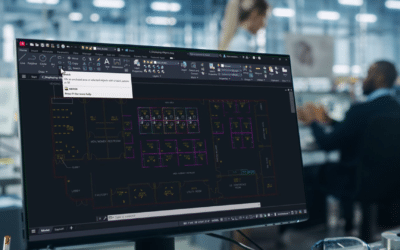

The latest release of Autodesk Revit 2027 reflects a clear shift in how BIM tools are evolving. With growing project complexity, tighter deadlines, and increased coordination demands, the focus is no longer just on design, but on working smarter and faster across connected workflows.
Revit 2027 introduces AI-powered assistance, deeper cloud integration, and meaningful automation improvements, all aimed at reducing friction in day-to-day tasks and helping teams stay aligned throughout the project lifecycle
AI comes directly into your workflow
One of the standout features in Revit 2027 is the introduction of the Autodesk Assistant.
Rather than navigating menus or searching for tools manually, users can now interact with their models using natural language. This allows you to:
- Ask questions about your model.
- Generate steps for documentation.
- Trigger basic modelling actions.
This marks a significant shift; AI is no longer external or experimental; it’s now embedded directly inside the design environment.
A more connected design ecosystem
Revit 2027 expands beyond a standalone application into a connected platform experience.
With tighter integration into Autodesk Forma, users can move seamlessly from early-stage site analysis to detailed BIM design. Tools like:
- Forma Site Design
- Forma Building Design
- Forma Data Management
are now more accessible within the Revit ecosystem, enabling smoother data flow and reducing the need to jump between disconnected tools. This means teams can access environmental data, run analyses, and collaborate in context; without breaking their workflow.
Real-time collaboration & issue management
Collaboration in Revit 2027 becomes more continuous and less reactive.
A key improvement is the native integration of Issues directly into Revit, allowing teams to:
- Create and track issues inside the model.
- Sync updates across shared environments.
- Resolve coordination challenges in real time.
This reduces the typical back-and-forth between tools and helps teams catch problems earlier in the process.
Automation that saves time where it matters.
Revit 2027 focuses heavily on reducing repetitive, time-consuming tasks. Key improvements include:
- Rule-based numbering to replace manual renumbering.
- Enhanced tagging and annotation controls.
- Streamlined interface behaviours.
While these updates may seem incremental individually, together they significantly reduce interruptions and improve overall productivity.
Performance & stability improvements
Under the hood, Revit 2027 delivers noticeable performance gains. Enhancements include:
- Faster and more reliable Dynamo execution.
- Improved computational performance with updated frameworks.
- Production-ready accelerated graphics for smoother navigation.
These updates make working with large, complex models more responsive and efficient in everyday use.
Discipline-Specific Enhancements
Architecture
Architects benefit from improved modelling consistency and sustainability insights.
- Carbon analysis is now integrated directly into workflows.
- Materials include carbon data for better decision-making.
- Improvements to walls, stairs, and design options increase predictability.
This allows design, performance, and documentation to stay aligned from the start.
Structural Engineering
Revit 2027 strengthens the link between design and analysis:
- Analytical models update automatically with physical changes.
- Improved rebar detailing adapts to design changes.
- Better handling of loads and boundary conditions.
These updates reduce rework and improve confidence in structural outputs.
MEP
For MEP workflows, the focus is on reliability and accuracy:
- Cleaner analytical geometry for energy modelling
- Guided setup processes to reduce configuration errors.
- Improved system alignment between design and analysis
This leads to more dependable simulation and performance outcomes.
Smarter data & model insights
Revit 2027 also introduces better visibility into model performance and health. With tools like Model Analytics and improved data synchronization:
- Teams can monitor model quality.
- Identify risks earlier.
- Maintain consistency across disciplines.
This supports better decision-making throughout the project lifecycle.
What this means for BIM teams
The biggest takeaway from Revit 2027 is not just new features, but a shift in direction. This release emphasizes:
- AI-assisted workflows instead of manual processes.
- Connected data environments instead of isolated tools.
- Continuous coordination instead of reactive fixes.
Ultimately, Revit 2027 helps teams spend less time managing workflows and more time focusing on design, analysis, and delivery.
Revit 2027 represents a step toward a more intelligent and connected BIM future. With AI embedded directly into the modelling environment, stronger cloud integration, and meaningful automation improvements, Autodesk is clearly moving toward a more streamlined and collaborative design ecosystem.
For BIM professionals, the value is clear: less friction, better coordination, and more time to design.