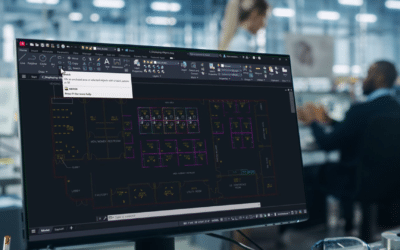

Small changes that can make a big difference to your daily workflow. Whether you're producing architectural drawings, engineering layouts or construction documentation, the way AutoCAD is configured can have a significant impact on how efficiently you work.
One of the biggest misconceptions we hear is that customising AutoCAD requires programming knowledge. Many of the most useful productivity improvements are built directly into the software and can be configured in just a few clicks.
If you're looking to work faster, reduce repetitive tasks and create a workspace that suits the way you work, here are ten simple AutoCAD customisations worth trying.
Personalise Your Quick Access Toolbar
The Quick Access Toolbar (QAT) sits at the top of AutoCAD and provides instant access to your most frequently used commands.
Instead of searching through Ribbon tabs every time you need a command, you can add the tools you use most often with a simple right-click. Likewise, removing commands you never use helps keep your workspace clean and focused.
For users who rely on a core set of tools every day, this small adjustment can save hundreds of clicks over the course of a project.

Maximise Your Drawing Area with Clean Screen
When you're working on detailed drawings, every bit of screen space counts.
AutoCAD's Clean Screen mode hides the Ribbon, palettes and other interface elements, allowing your drawing to take centre stage. Simply press CTRL + 0 to switch into Clean Screen mode and press it again to return to your normal workspace.
This is particularly useful when reviewing complex models or working on smaller displays.

Keep Palettes Accessible Without Getting in the Way
Tool palettes such as Properties, Layers and External References are invaluable, but they don't need to occupy valuable screen space all day.
By anchoring palettes to either side of your workspace, they collapse into slim tabs that expand only when you need them. This keeps your drawing area uncluttered while ensuring important tools remain only a mouse hover away.

Make Better Use of Right-Click Menus
Many users still use the right mouse button simply as an Enter key, but AutoCAD's contextual right-click menus can speed up common tasks considerably.
If you prefer using right-click to repeat commands, AutoCAD offers time-sensitive right-click. A quick click behaves as Enter, while holding the button slightly longer opens the contextual menu, giving you the best of both approaches.

Create Your Own Command Aliases
Command aliases are one of the simplest ways to speed up every day drafting.
AutoCAD stores these shortcuts in the acad.pgp file, allowing you to modify existing aliases or create your own.
For example, if there's a command you use constantly but don't like the default shortcut, you can assign one that's easier to remember. Many experienced users position their most-used aliases around the left-hand side of the keyboard, allowing them to keep one hand on the mouse while launching commands with the other.
These small improvements quickly add up across hundreds of commands every day.

Save Frequently Used Project Locations
If you regularly browse through the same project folders, AutoCAD's Places feature can save valuable time.
Within the Open or Save dialog, you can add commonly used folders to the Places panel, allowing you to jump directly to them instead of navigating through multiple folder levels each time.
It's a simple feature that becomes increasingly valuable when managing multiple live projects.

Reduce Ribbon Clutter
The AutoCAD Ribbon doesn't have to occupy a large portion of your screen.
You can minimise it to show only tabs, panel titles or buttons while retaining full functionality. This creates a cleaner workspace and leaves more room for your drawings without sacrificing quick access to commands.

Work Across Multiple Drawings with Floating Windows
If you regularly compare drawings or work across multiple monitors, floating drawing windows can make your workflow much more efficient.
Simply drag a drawing tab away from the main AutoCAD window to create a separate floating editor. Each floating drawing has its own Command Line while still allowing access to the main Ribbon and Quick Access Toolbar.
For users reviewing revisions or coordinating between multiple files, this feature can significantly improve productivity.

Create Different Workspaces for Different Tasks
Not every project requires the same tools. If you alternate between 2D drafting, 3D modelling, detailing or industry-specific workflows, creating multiple workspaces allows AutoCAD to present only the tools relevant to the task you're performing.
Switching between saved workspaces can help reduce distractions and improve efficiency throughout the working day.

Customise the Command Line
The Command Line has evolved into much more than a place to type commands.
Using the settings available from the Command Line's configuration options, you can customise search behaviour, command history and input preferences to better match the way you work.
Taking a few minutes to configure these settings can make AutoCAD feel far more responsive to your personal workflow.

Small Changes, Big Productivity Gains
Improving productivity in AutoCAD doesn't always require advanced automation or custom programming. Many of the most effective enhancements are already built into the software- you simply need to tailor them to the way you work.
Whether it's reducing mouse clicks, organising your workspace or speeding up common commands, these simple customisations can help you work more efficiently every day.
At TMS CADCentre, we've been helping businesses get the most from AutoCAD and Autodesk software for over 40 years. From accredited training courses to software advice and support, our team can help you streamline your workflows and improve productivity across your organisation.
If you'd like to learn more about getting the most from AutoCAD, get in touch with our team or explore our range of Autodesk training courses.